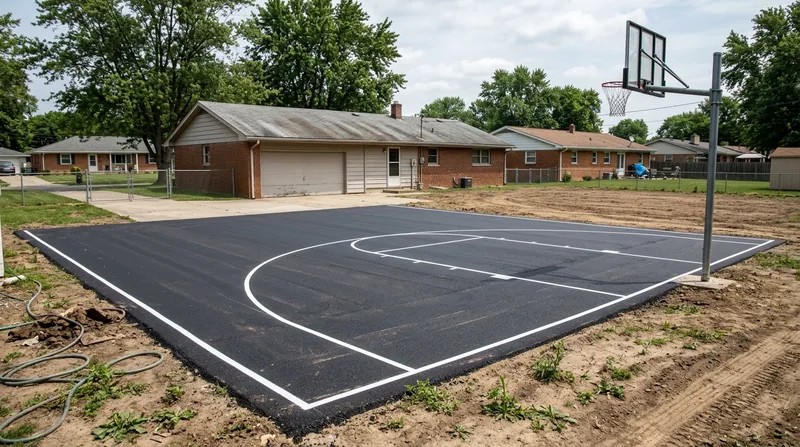




Sports Court & Path Paving in Fort Wayne requires a foundation built to handle clay-rich ground, freeze-thaw cycles, and the wet conditions that follow spring melt across the glacial plain. Whether you're building a backyard basketball court, a tennis surface, or a walking path connecting your property, the base must be compacted firm and flat over soil that holds water longer than sandy terrain. Fort Wayne sits on heavy clay from the old Lake Maumee lakebed, and frost heaves down past 36 inches in winter, so a shallow or poorly drained base will crack and shift within a season. We grade and compact an aggregate base thick enough to shed water and resist the freeze-thaw swings your court will face, then lay a smooth, durable hot mix asphalt surface sized for the activity and traffic you plan. The result is a court or path that plays true and lasts.
Why Sports Court & Path Paving Matters in Fort Wayne
A properly built court or path is not just a surface, it's a system. The asphalt you see is only the top layer. Underneath, the base must be solid, well-draining, and thick enough to handle the weight and movement of players, vehicles, or foot traffic without settling or cracking. In Fort Wayne, that base has to work against clay that expands when wet and contracts when it dries, creating heave and settlement that will destroy a thin or poorly compacted foundation. The frost line here reaches 36 inches, meaning winter cold works its way deep into the soil, and if water is trapped in the base, ice lenses form and push the surface up. When spring comes and the ice melts, the court sinks and cracks. A court built right stays flat and firm year after year.
- Proper grading sheds water away from the court and prevents standing puddles that accelerate freeze-thaw damage.
- A compacted aggregate base built below the frost line resists heave and keeps the surface from cracking and shifting.
- Hot mix asphalt provides a smooth, durable playing surface that handles both athletic use and weather extremes.
- Correct slope and drainage design prevent water from pooling at edges or corners where cracks start.
Courts and paths that fail early are almost always built on undersized or poorly compacted bases, often installed by crews unfamiliar with Fort Wayne's clay and frost conditions. A site visit and written estimate that includes base thickness and compaction specs is the difference between a court that lasts 15 years and one that cracks in three.
Key info: Fort Wayne's clay-rich glacial soil requires a base built past the frost line (36+ inches) with compaction and drainage specs in your written estimate. Ask your contractor to state the base thickness, aggregate type, and compaction method in tonnage or density before work begins.
For more on asphalt installation and base preparation, see our asphalt driveway paving service, which follows the same foundation principles.
How We Build Sports Courts and Paths in Fort Wayne
The work happens in stages, each one critical to the final result. We start with site grading, sloping the ground so water runs away from the court and does not collect at the edges. Next, we excavate and prepare the subgrade, removing topsoil and any soft material down to stable clay or sand. Then we bring in a compacted aggregate base, crushed stone sized and layered so it drains and resists settlement. We proof-roll the base with heavy equipment to confirm it's firm, then lay hot mix asphalt in lifts, compacting it hot so it bonds and cures properly. The whole process takes planning and local knowledge, especially in Fort Wayne where the soil and climate demand precision.
- We visit your site, measure the area, and check drainage and soil conditions.
- We grade and slope the surface to shed water, removing topsoil and soft material.
- We install a compacted aggregate base below the frost line, typically 4 to 6 inches, depending on soil and traffic.
- We proof-roll the base with heavy equipment to confirm compaction and stability.
- We lay hot mix asphalt in lifts, compacting each layer while hot to ensure density and bond.
- We finish with a smooth, crowned surface that sheds water and provides a true playing area.
The entire job, from grading to final asphalt, typically takes one to two weeks for a residential court, depending on weather and site conditions. New asphalt cures as it cools and hardens, and you should wait at least 48 hours before heavy use, longer in cool or wet weather.
Example: A 3,000-square-foot backyard basketball court in the Aboite area of Fort Wayne required 6 inches of compacted base over clay soil, plus grading to slope away from the house. We excavated, brought in crushed limestone in two lifts with proof-rolling between, then laid 2 inches of hot mix asphalt finished smooth. Work took 5 days; the owner had a playable court within a week.
Learn more about our grading and base preparation services for additional detail on how we handle Fort Wayne's challenging soil.
| Approach | Description | Best for |
|---|---|---|
| Full-depth court paving | Excavate, grade, install compacted base, and lay new hot mix asphalt surface. | New courts or courts on poor or uncertain soil; highest durability and control over base. |
| Court resurfacing | Mill or remove old asphalt, inspect base, and lay new hot mix surface over existing base if sound. | Courts with good base but worn or cracked surface; faster and lower cost than full-depth work. |
| Walking path paving | Grade and compact base for pedestrian use, lay hot mix asphalt in narrower widths (3 to 6 feet). | Connecting pathways, garden walks, or routes across property; lighter traffic allows thinner base. |
| Multi-sport court | Full-depth build with thicker base and precise slope for both tennis and basketball, or basketball and volleyball. | Residential or small institutional courts where multiple activities share one surface; requires precise grading. |
Sports Court & Path Paving Cost in Fort Wayne: What to Expect
A backyard sports court in Fort Wayne typically starts at $8,500 for a 2,500-square-foot court with proper grading, compacted base, and finished asphalt. Larger courts, paths, or sites with difficult soil or drainage challenges cost more. The factors that move the price are site size, base thickness and material, how much excavation and grading the soil requires, and whether you need drainage or utility work. A court on sandy soil near the confluence of the rivers south of downtown costs less to build than one on heavy clay in the northwest part of the city, because the clay demands thicker base and more careful compaction. A path across level ground with good drainage costs less than a court on a slope or in a low spot where water collects. Get two or three written estimates that include base thickness, compaction specs, and surface area. A low-ball estimate without those details is a red flag.
For a detailed pricing breakdown and examples of what different project sizes cost, visit our pricing page. If you'd like a free estimate for your specific site, call us at (260) 264-9248 or request an estimate online.
Sports Court & Path Paving Near Me: What Fort Wayne Homeowners Should Know When Hiring
Finding a contractor who understands Fort Wayne's soil and climate is the single most important step. Many crews cut corners on base preparation because it's invisible underground, but that's where the court's life is decided. Ask any contractor you're considering for a written estimate that includes the base thickness in inches, the type and amount of aggregate, the compaction method, and the finished asphalt thickness. If they can't or won't provide those details, move on. Check references from previous court or path jobs in Fort Wayne or nearby, and ask those homeowners whether their court has cracked or settled. Verify that the contractor is fully insured and carries liability coverage; ask to see the certificate. If your property is in an HOA or a historic district, check with your HOA or the city planning department before you start, because some communities have rules about court color, materials, or setbacks. Finally, get everything in writing: the scope of work, the timeline, the total cost, and what happens if weather delays the job. A handshake and a cash deposit is not a contract, and it's the setup for problems.
For help navigating permitting questions or to discuss your court project with our team, contact us or call (260) 264-9248. We've been serving Fort Wayne and the surrounding area since 2014.
Sports Court & Path Paving in Fort Wayne: Pricing Guide
| Service | Price | Details |
|---|---|---|
| Backyard sports court (2,500 sq ft) | Starting at $8,500 | Grading, compacted base, and hot mix asphalt surface for basketball or tennis, including slope and drainage design |
| Larger court or multi-sport surface (3,500 to 4,500 sq ft) | Starting at $12,000 | Full-depth build with thicker base for dual-use courts; cost varies with soil conditions and site drainage needs |
| Walking path paving (100 to 500 linear feet) | Starting at $2,800 | Grading and compacted base for pedestrian traffic, hot mix asphalt 3 to 6 feet wide; lighter base than sport courts |
| Court resurfacing (existing sound base) | Starting at $4,500 | Mill and remove old asphalt, inspect base, lay new surface; cost lower than full-depth if base is stable and drains well |
| Complex site or difficult soil | On estimate | Extensive grading, poor drainage, high water table, or utility conflicts require site visit before pricing |
| Free estimate | No cost | Response within 24 hours at (260) 264-9248; includes site measurement, soil assessment, and written proposal |
Indicative pricing, the exact cost depends on square footage, finish, and site access. Free personalized estimate within 24h at (260) 264-9248.


