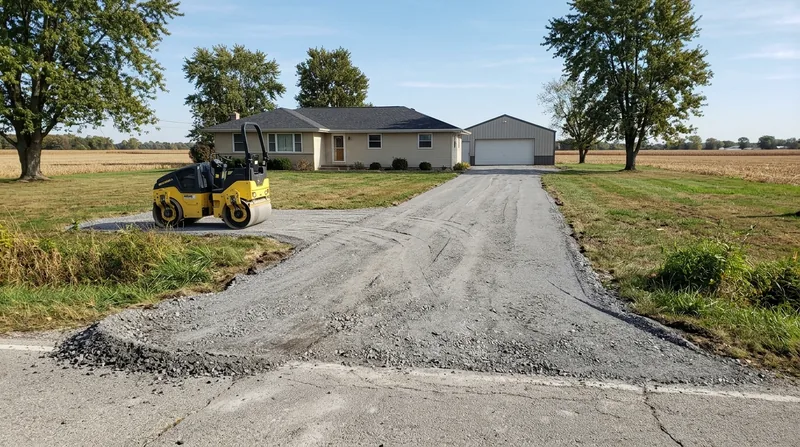




Recycled asphalt and millings driveways in Fort Wayne offer homeowners a solid, budget-conscious surface that handles the region's heavy clay subgrade and freeze-thaw winters without the full cost of virgin hot mix. Fort Wayne's glacial Lake Maumee plain sits under stubborn clay that holds water after rain, heaves as frost works down past 36 inches in winter, and softens a base not built to shed water. Recycled millings compact down into a stable wearing course over a properly graded base, shed water across flat lots, and cost roughly 40 to 50 percent less than new asphalt while delivering years of service for rural driveways, long private lanes, and secondary parking areas. We grade the base, lay reclaimed asphalt millings in lifts, and compact them so the surface bonds and hardens over time. If you need a durable, low-cost alternative to new asphalt or gravel, or if you're preparing a base for future asphalt driveway paving, recycled millings are worth a closer look.
Why Recycled Asphalt Millings Make Sense for Fort Wayne Driveways
Fort Wayne homeowners face a unique set of paving challenges tied to the region's geology and winters. The heavy clay underneath most of the city stays saturated longer than sandy soils, which means a driveway base must shed water or it will soften and fail. Recycled millings compact into a tight, water-shedding surface that performs well over clay, and the cost advantage over new asphalt is significant for rural properties, long approaches, and secondary drives where the extra durability of hot mix is not the priority. Millings also allow you to build a solid base now and upgrade to full asphalt later without tearing out what you have.
- Recycled millings compact into a tight, durable surface that hardens over several months as traffic and weather fuse the particles together.
- The material sheds water across flat slopes, critical over Fort Wayne's clay subgrade, so standing water does not soften the base.
- Cost is roughly 40 to 50 percent less than new asphalt, making millings the right choice for longer private drives and rural properties.
- Millings allow you to build a solid base now and resurface with hot mix asphalt later without demolition or base removal.
- The surface stabilizes within weeks and bonds tighter with each freeze-thaw cycle, which is the dominant failure mode in Fort Wayne winters.
For rural driveways, farm lanes, and properties where budget and long-term durability both matter, recycled millings deliver real value.
Key info: Fort Wayne sits over glacial clay that heaves in winter and holds water longer than sandy soils. A base that sheds water is not a luxury, it is the foundation of any drive that will survive repeated freeze-thaw cycles. Recycled millings, properly graded and compacted, shed water as well as new asphalt and cost far less.
For more on how base preparation affects long-term driveway performance, see our guide to gravel driveway installation and grading.
How We Install Recycled Asphalt Millings Driveways in Fort Wayne
Installation of a recycled millings drive is straightforward but requires attention to slope, compaction, and base preparation. We begin with a site visit to measure the driveway, check drainage patterns, and identify any soft spots or standing water. The base must be graded so water runs off the surface and does not pool at the edges or center. Once grading is set, we deliver recycled asphalt millings and spread them in lifts (typically 2 to 3 inches at a time), compact each lift with a vibratory roller, and repeat until the desired thickness is reached. The surface will continue to harden and bond over the first few months as traffic and weather work the particles together.
- We measure the driveway and assess the existing base for soft spots, standing water, or drainage problems that affect the millings installation.
- We grade the base so water sheds across the surface and does not collect at low points or along the edges.
- We deliver recycled asphalt millings and spread them in compacted lifts of 2 to 3 inches, using a vibratory roller to bond each layer.
- We repeat the lift-and-compact process until the surface reaches the thickness needed for your driveway and traffic pattern.
- The surface hardens over weeks and months as traffic consolidates the particles and weather fuses them into a stable wearing course.
The result is a solid, water-shedding drive that costs a fraction of new asphalt and lasts for years with basic maintenance.
Example: A 200-foot farm lane in Grabill with standing water at the low end and soft clay subgrade received a 4-inch recycled millings base, graded to slope away from the center. After three months and two winters, the surface had hardened into a stable, water-shedding drive that shed water across the slope and required only light raking to maintain.
For details on how we handle complex base preparation and grading, see our page on asphalt milling and removal, which covers excavation and base work.
Recycled Asphalt Millings Installation Methods and Options
| Method | Description | Best For |
|---|---|---|
| Recycled Millings Over Existing Base | Spread and compact recycled asphalt over a graded, stable subgrade or existing compacted base. | Rural driveways, farm lanes, secondary parking, and properties where the existing base is sound but the surface has failed. |
| Full-Depth Recycled Millings Installation | Remove failed pavement and soft subgrade, regrade for drainage, and install recycled millings in compacted lifts from the clay up. | Long private drives, farm access roads, and properties with heavy clay and drainage issues that require a fresh base. |
| Millings as a Base for Future Asphalt | Install recycled millings in a stable, compacted base layer now, with the plan to overlay with hot mix asphalt in the future. | Properties where budget is tight today but a long-term upgrade to asphalt is planned within 3 to 5 years. |
| Millings with Geotextile Separation | Lay a geotextile fabric over soft clay or poor subgrade, then install recycled millings over the fabric to prevent mixing and improve drainage. | Properties with very soft clay, high water tables, or standing water issues that require extra separation and drainage control. |
Recycled Asphalt and Millings Driveways Cost in Fort Wayne: What to Expect
The cost of a recycled asphalt millings driveway in Fort Wayne typically starts at around $3 per square foot for material and installation over a stable, well-draining base. A 600-square-foot driveway would run roughly $1,800 to $2,400, depending on the thickness of the millings layer, the amount of grading and base preparation required, and the condition of the subgrade. Soft clay, standing water, or the need to remove and replace failed pavement will increase the cost. A free site estimate is the only way to know the real number for your property, because the cost depends entirely on what lies under the surface and how much work the base requires.
- Material cost for recycled millings is roughly 40 to 50 percent less than new asphalt, making it the budget option for longer drives and rural properties.
- Grading and base preparation add to the cost if the existing base is soft, slopes poorly, or requires excavation to correct drainage problems.
- Thickness of the millings layer affects cost, with 3 to 4 inches typical for a driveway and 4 to 6 inches for a private road or heavy-traffic lane.
- Removal of failed pavement or soft subgrade increases the cost, but is necessary if the base will not support a new surface.
- Site access and distance affect delivery and labor, though we include travel in Fort Wayne and surrounding areas without a separate mileage fee.
Get a free written estimate by calling (260) 264-9248 or visiting our pricing page for more detail on factors that affect cost.
Recycled Asphalt and Millings Driveways Near Me: What Fort Wayne Homeowners Should Know When Hiring
Choosing a contractor for recycled asphalt or millings work is straightforward if you follow a few simple rules. First, get a written estimate that includes the thickness of the millings layer, the square footage, and the tonnage or cubic yards of material that will be delivered. Do not accept a verbal quote or a price per square foot without a site visit, because the cost depends on what you find under the surface. Second, verify that the contractor is fully insured and ask for a certificate of insurance. Third, ask for references from recent millings or driveway projects in Fort Wayne or the surrounding area, and call at least one to ask about the durability and appearance of the finished drive. Fourth, confirm that the contractor will handle any required permitting with the city or county, or will guide you through the process, because some jurisdictions require a driveway permit even for material placement.
- Ask for a written estimate that specifies the thickness of the millings layer, the tonnage of material, and the total cost before work begins.
- Verify that the contractor is fully insured and ask for a certificate of insurance that covers liability and property damage.
- Request references from recent projects in Fort Wayne or nearby areas, and call at least one homeowner to ask about durability and maintenance.
- Confirm that the contractor will handle or guide permitting with the Fort Wayne Building Department or the relevant township, because requirements vary by jurisdiction.
- Avoid contractors who offer unsolicited door-to-door quotes, demand a large cash deposit, or promise a price before visiting the site.
For a free estimate and to discuss your driveway or lane, contact us today or call (260) 264-9248.
Recycled Asphalt & Millings Driveways in Fort Wayne: Pricing Guide
| Service | Price | Details |
|---|---|---|
| Recycled Asphalt Millings, Standard Installation | Starting at $3/sq ft | 3 to 4 inches of recycled millings, graded and compacted over stable base, includes labor and material |
| Millings with Base Preparation and Grading | Starting at $4/sq ft | Includes regrading for drainage, compaction, and millings installation, necessary when existing base is soft or slopes poorly |
| Full-Depth Recycled Millings Installation | On estimate | Removal of failed pavement, excavation, subgrade preparation, and millings installation; requires site visit to assess depth and condition |
| Millings as Base Layer for Future Asphalt Overlay | Starting at $2.50/sq ft | Recycled millings installed as compacted base layer, designed to receive hot mix asphalt overlay within 3 to 5 years |
| Free Estimate | Free | Written estimate with tonnage, thickness, and total cost; response within 24 hours at (260) 264-9248, no obligation to book |
Indicative pricing, the exact cost depends on square footage, finish, and site access. Free personalized estimate within 24h at (260) 264-9248.


